Our Story
How a simple observation — that perfectly good tanks were being thrown away — became the Midwest's most trusted IBC operation.
Get a Free Quote
Tell us what you need and we'll get back to you within 24 hours.
It Started With a Simple Question
In warehouses and loading docks across Nebraska, the same scene plays out every week: intermediate bulk containers — those 275-gallon polyethylene tanks inside steel cages — arrive full of food-grade liquids, chemicals, or agricultural products. Once emptied, many are stacked in a corner and eventually hauled off to the landfill. One use. Done.
Our founders saw this waste loop up close for years. They knew these containers were engineered to last through dozens of fill cycles. The HDPE bladders resist UV and chemicals. The galvanized steel cages can handle stacking loads of thousands of pounds. The integrated pallet base is built for forklift handling. Throwing them out after one use is not just wasteful — it is economically irrational.
So they asked the question that launched Omaha IBC Tanks: What if we created a system that kept these tanks moving from one user to the next, cleaned and inspected between each use, until every last bit of value was extracted?
The answer became this company. Today, from our facility at 8520 G St, Omaha, NE 68127, we operate a full circular-economy service for IBC tanks — buying, selling, cleaning, reconditioning, modifying, transporting, and recycling. Every tank that passes through our yard gets the longest, most productive life possible.
What makes our story unique is not just the environmental mission — it is the fact that every part of our business model reinforces every other part. When we buy a used tank from a food manufacturer, that manufacturer saves on disposal costs. When we recondition and sell that tank to a farmer, the farmer saves 60-70% compared to buying new. When that tank eventually reaches the end of its life, we disassemble it and send every component — plastic, steel, and wood — to the appropriate recycling stream. Zero waste. Full circle.
Meet the Founders
Omaha IBC Tanks was founded by two industry veterans who saw the same problem from different sides of the supply chain — and realized the solution required combining their expertise.
The Operations Founder
With over 15 years of experience in food production and logistics management across Nebraska, our operations founder built and managed warehouse systems for two of the state's largest food distributors before launching Omaha IBC Tanks. His expertise in supply chain optimization and industrial cleaning protocols forms the backbone of our reconditioning process. He personally designed the layout of our G Street facility to maximize throughput while minimizing water and energy waste.
Current Focus: Oversees all facility operations, reconditioning quality standards, equipment maintenance, and safety compliance. Handles the design and implementation of new cleaning technologies and process improvements.
The Business Founder
Coming from the chemical distribution industry in Iowa, our business founder spent a decade managing B2B sales and logistics for bulk chemical suppliers. He saw the waste problem from the buyer's side — companies paying premium prices for new containers when perfectly good used ones were heading to the dump. His deep network of contacts in manufacturing, agriculture, and chemical distribution across the Midwest became the foundation of our customer base.
Current Focus: Leads sales, customer relationships, pricing strategy, and partnership development. Manages our growing network of supply partners and oversees the company's expansion into new markets and service territories.
Our Journey
A Problem Worth Solving
Our founders spent years in the food production and chemical distribution industries across Nebraska and Iowa. They watched firsthand as thousands of structurally sound IBC tanks were hauled to landfills after a single use. The math was staggering: each discarded tank represented 130 pounds of high-density polyethylene, a steel cage, and a wooden pallet — all destined for a hole in the ground. There had to be a better way.
From Garage to Yard
What started as a side operation — collecting used totes from local food manufacturers and reselling them to farmers — quickly outgrew the original storage space. Word spread through the Omaha business community that someone was offering clean, inspected IBC tanks at a fraction of the cost of new ones. Demand proved the concept within months.
Building the Core Team
As order volume doubled and then tripled, we brought on our first full-time employees: a logistics coordinator who had run warehouse operations for a regional food distributor, and two yard technicians with hands-on experience in industrial cleaning and container repair. This small but capable team allowed us to standardize our inspection process and handle same-day orders reliably.
The G Street Facility
We secured our current location at 8520 G St in Omaha — a 15,000-square-foot facility with dedicated zones for intake, cleaning, reconditioning, storage, and shipping. The site includes a covered wash bay with water reclamation, a welding and cage repair station, and enough outdoor yard space to stage over 800 IBC tanks simultaneously. Being near the I-80 and I-480 interchange gave us fast access to every part of the metro and beyond.
Industrial-Scale Reconditioning
We invested in professional cleaning and reconditioning equipment including a triple-rinse automated wash system with water heated to 180 degrees Fahrenheit, a closed-loop water reclamation system that recycles 85% of rinse water, and a pneumatic pressure-testing rig capable of handling 40 tanks per day. These upgrades moved us from a reseller into a full-service reconditioning operation.
Supply Chain Integration
Partnerships with manufacturers, breweries, food processors, and agricultural operations across Nebraska, Iowa, Kansas, and Missouri created a steady two-way flow of tanks. We signed recurring pickup contracts with over 30 industrial facilities, ensuring consistent supply while helping those businesses reduce waste disposal costs. Several of these original partners still work with us today.
Giving Back to Omaha
We launched our community donation program, providing free reconditioned IBC tanks to local community gardens, urban farms, and Habitat for Humanity build sites for rainwater collection. We also began partnering with Metropolitan Community College to offer hands-on internship opportunities in industrial recycling and logistics operations, providing students with practical workforce skills.
10,000 Tanks Diverted
We reached a major milestone: 10,000 IBC tanks diverted from landfills since founding. This single number represents over 650 tons of HDPE plastic, 425 tons of galvanized steel, and 200 tons of wood pallet material kept in productive circulation. Local media coverage of this milestone brought a wave of new business from sustainability-minded companies across the region.
Dedicated Delivery Fleet
We built out a dedicated pickup and delivery fleet including flatbed trucks, a box truck for smaller orders, and a forklift-equipped trailer for on-site loading and unloading. Route optimization software was implemented to minimize fuel use and maximize stops per trip. This investment cut our average delivery lead time from 3-5 days to just 1-2 days across the metro area.
The Midwest's IBC Hub
Omaha IBC Tanks now processes thousands of containers every year with a team of 14 full-time employees. We offer a complete lifecycle service — buying surplus tanks, reconditioning them to rigorous standards, selling them to new users, and responsibly recycling units that have reached end-of-life. Our 98% landfill diversion rate means virtually nothing we touch goes to waste.
Scaling Sustainability
Our goal is to become the largest circular-economy IBC operation in the central United States. We are expanding our reconditioning capacity to 200 tanks per day, building new partnerships with municipal and agricultural water management programs, and investing in tracking technology so every tank's journey is documented from first fill to final recycle.
Company Growth at a Glance
From two people and a rented lot to a 15,000-square-foot facility processing over 12,000 tanks per year — here is how the numbers have grown.
| Period | Team Size | Facility (sq ft) | Tanks Processed / Year |
|---|---|---|---|
| Year 1 | 2 | 2,000 | 400 |
| Year 2 | 4 | 5,000 | 1,200 |
| Year 3 | 7 | 10,000 | 3,500 |
| Year 4 | 10 | 12,000 | 6,000 |
| Year 5 | 14 | 15,000 | 9,000 |
| Today | 14 | 15,000 | 12,000+ |
What We Stand For
These are not aspirational slogans — they are the operating principles that guide every tank we inspect, every price we quote, and every delivery we make.
Environmental Responsibility
Every decision we make starts with the question: what is the most sustainable path? We exist to keep materials in circulation and out of landfills.
Honest Business
We grade every tank accurately, price fairly, and never sell a container we wouldn't use ourselves. Transparency builds the trust our customers rely on.
Community First
We are Omaha born and Omaha committed. Our team lives here, our families are here, and the businesses we serve are our neighbors. Supporting the local economy is personal.
Continuous Improvement
We invest in better cleaning systems, smarter logistics, and deeper expertise. The IBC industry evolves and we stay ahead of it so our customers don't have to.
Safety Without Compromise
Every team member is trained in OSHA standards, chemical handling protocols, and equipment operation. We conduct monthly safety audits and maintain a zero-incident target every quarter.
Customer Partnership
We do not think in transactions — we think in relationships. Many of our customers have been with us for years because we treat their needs as our own and always deliver on our word.
Awards & Recognition
Our commitment to sustainability and business excellence has been recognized by local and regional organizations.
Nebraska Green Business Award
Nebraska Department of Environment and Energy
Small Business Excellence Award
Greater Omaha Chamber of Commerce
Circular Economy Innovation Recognition
Midwest Sustainability Network
Best of Omaha — Industrial Services
Omaha Magazine Readers' Choice
Environmental Stewardship Award
Nebraska Recyclers Association
Top 50 Green Businesses in the Midwest
Midwest Business Journal
Community & Industry Partnerships
We believe business success and community impact go hand in hand. Here are some of the organizations we are proud to partner with.
Metropolitan Community College
Internship program for industrial recycling and logistics students.
Omaha Food Bank
Free reconditioned tanks for food-grade water storage at distribution centers.
Nebraska Recyclers Association
Active member contributing to state recycling policy and best practices.
Habitat for Humanity Omaha
Donated IBC tanks for rainwater collection on new home builds.
Midwest Agricultural Cooperative
Recurring tank supply and buyback for 50+ member farms across NE and IA.
Keep Omaha Beautiful
Annual sponsor and participant in citywide cleanup and recycling education events.
Our Team Philosophy
We hire people who care about doing things right — not just getting things done. Every member of our team, from the yard crew inspecting incoming tanks to the logistics coordinators scheduling deliveries, understands that their work has a direct environmental impact.
Our culture is hands-on. Leadership works alongside the team on the yard floor. There are no ivory towers here — just people who know IBC tanks inside and out and take pride in matching the right container to the right customer.
We invest heavily in training. Every new team member completes a 40-hour onboarding program covering IBC construction and materials, cleaning chemistry, grading standards, safety protocols, and customer communication. Ongoing training happens monthly, and we bring in outside experts for specialized topics like food-grade sanitation standards and hazardous materials handling.
We believe in cross-training. Everyone on our team understands the full lifecycle of an IBC tank, from manufacturing specs to reconditioning protocols to recycling processes. This depth of knowledge means any team member can answer your questions with real expertise, not scripted responses.
Safety and quality are non-negotiable. Every tank is inspected against a rigorous checklist before it leaves our facility. We would rather lose a sale than ship a container that does not meet our standards.
Retention matters to us. Our average employee tenure is over 3 years, which is well above the industry norm for physical operations work. We attribute this to fair pay, consistent schedules, a safe working environment, and a genuine sense of purpose — our team knows their work keeps thousands of tons of material out of landfills every year.
Inside Our Facility
Our 15,000-square-foot facility at 8520 G St is purpose-built for IBC tank processing. Here is what you will find when you visit.
Intake & Grading Yard
The front yard where incoming tanks are received, cataloged, and assigned to the appropriate processing track. Each tank is tagged with a unique ID, its previous contents are recorded, and an initial condition grade is assigned. This area can stage up to 200 incoming tanks at a time.
Covered Wash Bay
Our enclosed wash station features a triple-rinse system with 180-degree heated water, FDA-approved cleaning agents, and high-pressure jets that reach every interior surface of the HDPE bottle. The closed-loop water reclamation system beneath the bay captures, filters, and recycles 85% of all rinse water used.
Cage Repair & Welding Station
A dedicated area for steel cage inspection and restoration. Our welders repair bent bars, reinforce weakened joints, and replace damaged cage sections. Cages beyond repair are disassembled and sent to our steel recycling partner. All repair work meets original manufacturer specifications.
Reconditioning Line
The heart of our operation: a linear processing flow where cleaned bottles are reunited with restored cages, fitted with new valves and gaskets, and pressure-tested for leak-free operation. Each station has a dedicated technician and a quality checklist posted at eye level.
Ready Inventory Storage
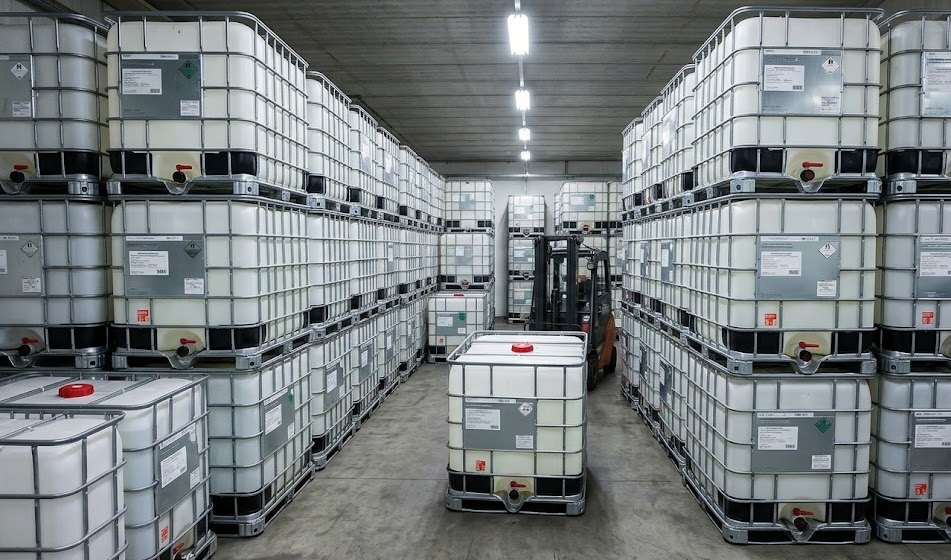
Over 600 finished tanks — graded, labeled, and shrink-wrapped — are staged in our organized storage area, ready for immediate pickup or delivery. Tanks are sorted by grade and size, making it easy for walk-in customers to browse and for our team to pull orders quickly.
Shipping & Loading Dock
Our loading dock accommodates flatbed trucks, box trucks, and customer pickups simultaneously. Two dock-height bays handle palletized loads, while ground-level access with a forklift serves flatbed and trailer loading. On a busy day, we ship out 40 or more tanks from this area.
Where We Are Headed
Our five-year roadmap is built around three pillars: capacity, technology, and geographic reach. We plan to triple our reconditioning throughput to 200 tanks per day by adding a second automated wash line and expanding our facility to 25,000 square feet. This investment will allow us to serve enterprise customers with recurring needs of 500 or more tanks per month.
On the technology front, we are piloting an RFID-based tank tracking system that will give every container a digital identity. Customers will be able to scan a tank and see its complete history: manufacture date, previous contents, cleaning records, inspection results, and remaining estimated service life. This transparency will set a new standard for the used IBC industry.
Geographically, we intend to establish satellite collection and distribution points in Kansas City, Des Moines, and Sioux Falls. These smaller depots will reduce transportation distances for our regional customers and allow us to capture more used tanks from areas currently underserved by the circular economy.
We are also deepening our partnerships with municipal water programs, emergency management agencies, and agricultural cooperatives. Bulk water storage is a growing need across the Great Plains, and reconditioned IBC tanks are the most cost-effective solution available. We want to be the preferred supplier for every organization in the central U.S. that needs reliable, affordable bulk containers.
Ultimately, our vision is simple: no IBC tank in the Midwest should end up in a landfill while there is still useful life in it. We are building the infrastructure, the team, and the technology to make that vision a reality.
Rooted in Omaha, Serving the Midwest
Our facility at 8520 G St, Omaha, NE 68127 is strategically positioned to serve businesses across Nebraska, Iowa, Kansas, Missouri, South Dakota, and beyond. Located near major interstate corridors, we can get tanks to you quickly and cost-effectively.
Whether you are a food manufacturer in Council Bluffs, a farm operation in central Nebraska, or a chemical distributor in Kansas City, we are close enough to make logistics simple and affordable.
Walk-in customers are always welcome during business hours. Come see our facility, inspect inventory in person, and meet the team that will be handling your order. We believe in face-to-face relationships, and there is no substitute for seeing the quality of our operation with your own eyes.
Service Area Highlights
- Omaha Metro & Council Bluffs — same-day available
- Lincoln & Eastern Nebraska — next-day delivery
- Des Moines & Western Iowa — 1-2 business days
- Kansas City Metro — 1-2 business days
- Sioux Falls & South Dakota — 2-3 business days
- Wichita & Central Kansas — 2-3 business days
- St. Louis & Eastern Missouri — 3-4 business days
- Wider Midwest — custom logistics available
Community Involvement
Being a local Omaha business means more than having a local address. We actively invest time, resources, and expertise in the community that supports us. Our community involvement falls into three categories: environmental education, workforce development, and direct material support.
On the education side, we host facility tours for school groups and community organizations, demonstrating how the circular economy works in practice. We have hosted over 30 tours in the past two years, reaching more than 500 students and community members. These tours cover the environmental impact of single-use containers, the reconditioning process, and career opportunities in industrial recycling.
For workforce development, our partnership with Metropolitan Community College provides paid internships for students in logistics, industrial technology, and environmental science programs. To date, three former interns have become full-time employees.
On the material support side, we donate reconditioned IBC tanks to community gardens, urban farms, Habitat for Humanity builds, and emergency preparedness organizations. In the past year alone, we donated over 40 tanks for rainwater collection and community irrigation projects. We also participate annually in Keep Omaha Beautiful cleanup events, contributing both volunteer hours and recycling expertise.
Sustainability Mission
Explore our environmental impact data, circular economy philosophy, and green practices.
Learn moreWhy Choose Us
See the competitive advantages that make Omaha IBC Tanks the right choice for your business.
Learn moreGet in Touch
Have questions or ready to place an order? Contact our team for a free, no-obligation quote.
Contact us